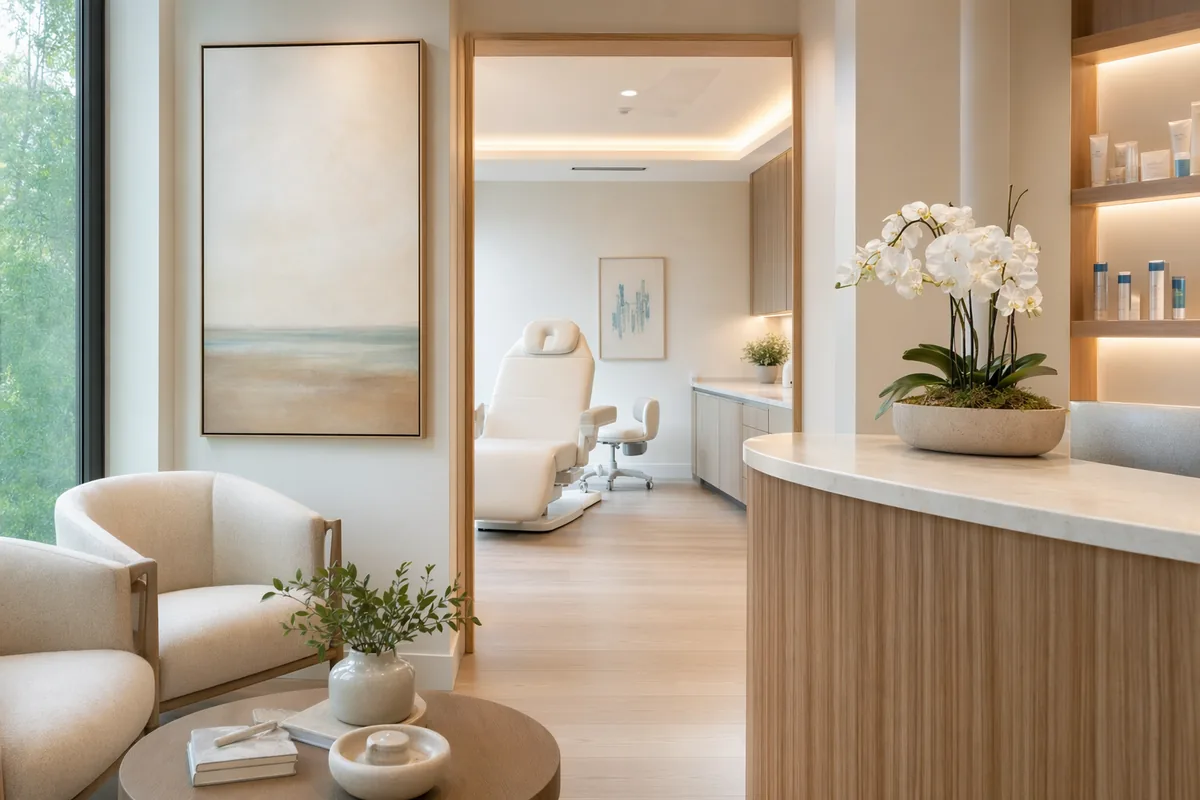
What Makes a Med Spa Different from a Day Spa
A med spa is a hybrid facility that combines the relaxing environment of a day spa with clinical procedures performed under the supervision of a licensed medical professional — usually a physician, nurse practitioner, or physician assistant. A day spa, by contrast, offers non-medical services like massage, manicures, and surface-level facials.
The legal difference is real. Med spas operate under medical director oversight in most US states and can administer FDA-cleared devices such as lasers, radiofrequency microneedling, and ultrasound skin tightening. Day spas cannot.
Roughly 95 percent of treatments at a typical med spa require injection, energy-based devices, or medical-grade topicals — categories that sit outside a day spa’s scope of practice. That is why every first-time consultation happens with a clinical provider, not a front-desk esthetician, and why intake forms ask for medication history, allergies, and prior procedures.
How to Prepare for Your First Med Spa Visit
Preparing for a first-time med spa visit takes about 15 minutes of homework that pays off during the consultation. Bring a current medication and supplement list, a written goal (for example, “reduce forehead lines” or “fade brown spots from sun damage”), and one or two reference photos of results you like.
Avoid blood thinners in the 5 to 7 days before the visit only if a specific treatment is already planned — aspirin, ibuprofen, fish oil, and vitamin E can all increase bruising risk. Alcohol in the 24 hours before the appointment has the same effect.
Most clinics require a clean face at arrival, so skip makeup and avoid retinoids or exfoliating acids for 48 hours ahead. For waxing or depilatory services on the treated area, allow at least 2 weeks of regrowth. Bring a payment method and a driver if the visit includes sedation or post-procedure blurred vision.
What Happens During a Med Spa Consultation
A med spa consultation is the 20-to-45-minute clinical intake that every reputable med spa runs before any treatment. A licensed provider — nurse practitioner, physician assistant, or MD — reviews the intake form, examines the treatment area, and discusses realistic outcomes.
The consultation has four components: medical history review, skin or body assessment, goal alignment, and a written treatment plan with itemized pricing.
Providers often use a handheld skin analyzer or standardized photography during the assessment. Those tools document baseline pigmentation, texture, and fine-line depth so progress can be measured objectively across multiple sessions.
About 60 to 70 percent of first-time visitors receive at least one treatment the same day when the consultation confirms candidacy and the schedule allows. The rest book a return appointment, typically 1 to 2 weeks out, to leave time for informed consent review and pre-treatment skin prep.
Common Treatments Offered at a Med Spa
A typical med spa menu falls into five broad categories: injectables, skin resurfacing, laser and light-based therapy, body contouring, and hair or scalp treatments. Each category contains 3 to 8 specific services offered on a rotating basis depending on the clinic’s equipment and staff.
Injectables are the highest-volume category at most US clinics, accounting for roughly 60 percent of revenue at a general-practice med spa in 2025. Skin resurfacing (chemical peels, microneedling) and laser-based services split most of the remaining volume.
Body contouring and skin tightening use non-invasive devices — radiofrequency microneedling and ultrasound are two common examples — to produce gradual collagen-based lift over 6 to 12 weeks. Hair restoration typically uses platelet-rich techniques and low-level light therapy.
A clinic’s menu usually reflects its equipment investment. A standard full-service med spa runs $250,000 to $600,000 in device capital, which explains why smaller clinics often specialize in 2 or 3 categories only.
How Much a Typical Med Spa Visit Costs
A first-time med spa visit usually breaks into two line items: the consultation fee and the treatment cost. Consultation fees range from $0 (waived with a same-day treatment) to $150 at higher-end clinics. Treatment pricing depends on category.
Injectable treatments start around $300 and climb past $1,500 for multi-area sessions. Chemical peels run $150 to $450 per session, and microneedling sessions fall between $250 and $700 depending on add-ons. Laser resurfacing is the widest range: $200 for a single IPL spot treatment, up to $3,500 for a full-face ablative laser.
Most clinics offer 3-to-6-session packages at 10 to 20 percent off the per-session rate. Memberships are increasingly common, bundling monthly credits at $99 to $299 per month.
Insurance does not cover cosmetic med spa services. HSA and FSA funds are sometimes eligible for medical-dermatology services such as acne treatment or keratosis removal — ask the clinic for a proper billing code.
What to Expect After a Med Spa Visit
Post-treatment recovery at a med spa visit varies by procedure, but most non-ablative services allow a same-day return to normal activity. Expect mild redness, slight swelling, or warmth at the treated area for 2 to 24 hours.
Injectable sites may show pinpoint bruising for 3 to 7 days — arnica gel, cold compresses, and avoiding aspirin help speed resolution. Microneedling leaves a sunburn-like flush for about 48 hours; makeup is usually cleared by the 24-hour mark.
Ablative laser, deep chemical peels, and aggressive resurfacing require 5 to 10 days of visible downtime with peeling, crusting, or pinkness. Strict sun avoidance and SPF 50+ for 4 weeks after any resurfacing is non-negotiable; UV exposure during this window causes hyperpigmentation in up to 30 percent of cases.
Clinics supply written aftercare specific to the service. Missing the follow-up skin-care protocol is the single biggest cause of sub-optimal results in the first 90 days.
How to Choose the Right Med Spa
Choosing the right med spa comes down to five hard checks: the medical director is a board-certified MD or DO, every injector is a licensed NP, PA, or RN with injectable-specific training, the clinic discloses its device brands and FDA clearances, the intake process includes a written consent form, and online reviews reflect at least 100 verified treatments.
Verify the medical director’s board certification on the state medical board website. Verify injectors by asking for their license number and training certificates — Allergan Medical Institute, Galderma, and similar manufacturers run certified programs.
Regional clinics like Call of Beauty Med Spa in Encinitas, California, publish injector credentials and treatment photos openly — a sign of a trust-first operation rather than a discount-driven one.
Price should never be the deciding factor. The lowest-priced injector in a market often reflects bulk diluted product, undertrained staff, or missing liability insurance, any of which carries real medical risk.
Key Takeaways
- A med spa is a medically-supervised aesthetic facility where licensed providers (NP, PA, or MD) administer FDA-cleared treatments not offered at day spas.
- A first-time med spa consultation takes 20 to 45 minutes and covers medical history review, skin assessment, goal alignment, and written pricing.
- About 60 to 70 percent of first-time med spa visitors receive a same-day treatment when candidacy is confirmed during the consultation.
- Typical first-visit costs range from $0 for a waived consultation up to $3,500 for full-face laser resurfacing, with packaged services running 10 to 20 percent off per-session rates.
- Mild redness, swelling, or bruising after most med spa treatments resolves within 2 to 24 hours; ablative laser or deep peels require 5 to 10 days of visible downtime.
- SPF 50+ and strict sun avoidance for 4 weeks after any resurfacing procedure is non-negotiable; failing to comply causes hyperpigmentation in up to 30 percent of patients.