Why Boilers Mattered in Early Rhode Island
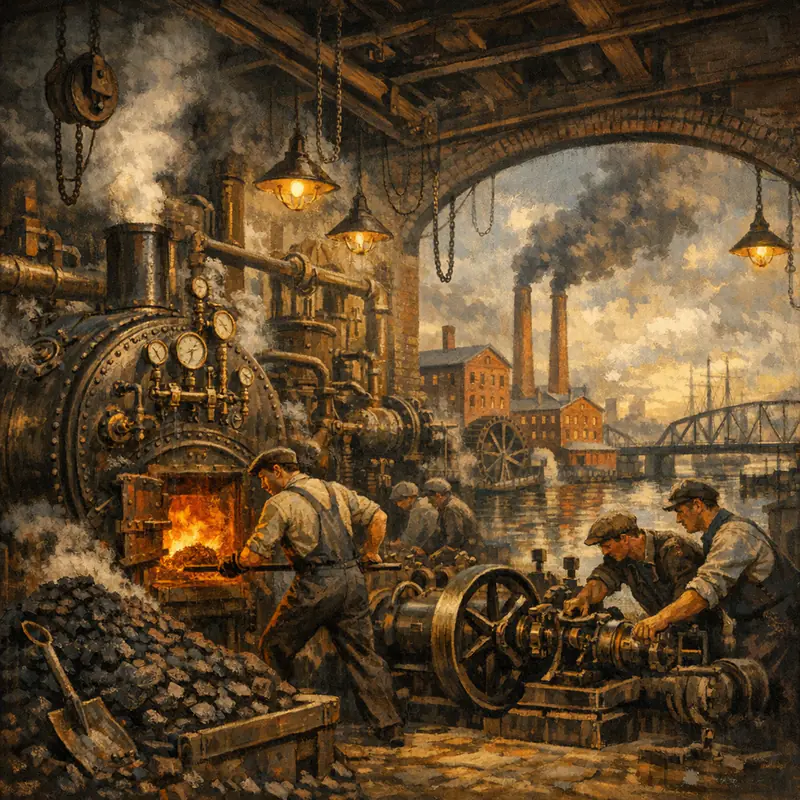
Rhode Island’s role in the American Industrial Revolution extended far beyond spinning looms and textile production. Steam boilers became the driving force that allowed factories to operate year-round, independent of rivers and weather. This shift unlocked faster production, larger facilities, and a new era of industrial reliability.
- Enabled factories to move beyond water-powered systems
- Provided consistent mechanical power for mills and workshops
- Laid the groundwork for large-scale manufacturing
How Boiler Manufacturing Took Hold
As textile mills multiplied in the late 1700s and early 1800s, demand for dependable steam systems surged. Early boilers were simple and risky by modern standards, but they represented a massive leap forward for industrial productivity. Rhode Island quickly became a center for refining these systems, combining mechanical skill with practical engineering.
By the mid-19th century, local manufacturers were producing boilers and steam engines used across the Northeast and beyond. Companies such as the Providence Steam Engine Company and the Corliss Steam Engine Company earned national recognition for their craftsmanship and performance. boiler repair and install
Key Engineering Advancements
Rhode Island’s boiler industry stood out because of its emphasis on innovation. Engineers in the state focused on improving efficiency, fuel consumption, and operational control.
Notable breakthroughs included:- The Corliss steam engine (1849), which dramatically reduced fuel waste
- Advanced valve and cut-off systems that improved pressure regulation
- Safer boiler designs that lowered the risk of catastrophic failures
These improvements allowed factories to expand in size and complexity, helping define the modern industrial plant.
Economic Effects Across the State
Boiler manufacturing became a major economic driver for Rhode Island throughout the 1800s and early 1900s. Skilled labor was in constant demand, supporting machinists, ironworkers, draftsmen, and maintenance crews.
- Thousands of steady manufacturing jobs
- Increased investment in railroads and shipping
- Growth of supporting trades and metalworking shops
Firms like Brown & Sharpe Manufacturing Company and regional engine builders helped establish Providence and surrounding cities as industrial powerhouses.
The Human and Cultural Legacy
Steam-powered industry reshaped daily life in Rhode Island. Entire neighborhoods grew around mills and factories, influencing housing, immigration patterns, and local economies. Boilers were not just machines — they were the heartbeat of working communities.
Today, this legacy lives on through preserved mill buildings, industrial museums, and restored equipment that reflect the state’s engineering heritage.
Looking Back at a Steam-Driven Era
The story of Rhode Island’s boiler industry is ultimately a story of adaptation and innovation. By embracing steam power, the state positioned itself at the forefront of industrial progress. The principles developed during this era continue to influence modern heating, power generation, and mechanical systems used today.